
M. Fatih Karakaya, Ass. Prof., Department of Sociology, Istanbul University. muhammed.karakaya@istanbul.edu.tr, and Guest Researcher, Department of Sociology, University of Copenhagen. m.karakaya@soc.ku.dk
In early September, Berlin buzzed with sociological energy as scholars from across Europe and beyond gathered at the Weizenbaum Institute for the 2025 Midterm Conference of the European Sociological Association’s Economic Sociology Research Network (RN09). Over three lively days (from 3rd till 5th of September), participants came together to explore a timely and hopeful theme, titled “Exploring Solutions to the Challenges of Our Time: A Positive Turn in Economic Sociology?”, asking how their discipline might not only critique the world, but help to change it. Hosted in one of Europe’s most vibrant research hubs, the event marked a moment of intellectual renewal for a field long renowned for its critical insight into the social foundations of economies.
At a time of intersecting crises, from social inequalities to climate change, technological disruption, global health emergencies and so on, the conference invited participants to reflect on how economic sociology might not only diagnose but also remedy the fractures of contemporary capitalism. Over three intense days of keynotes, panels, and early-career workshops, the question resonating through the Weizenbaum Institute’s corridors was: Can economic sociology become a discipline of solutions as much as critique?
A Call for a “Positive Turn”
The conference theme framed this challenge as a call for a “positive turn”, or put it simply, an invitation to reimagine the discipline’s role in shaping equitable and sustainable economies. While economic sociology has traditionally excelled at uncovering the embeddedness of markets in social structures and cultural/moral frameworks, the organizers encouraged participants to think beyond critique. The aim was to “provide a platform where critical analysis seamlessly intersects with creative problem-solving.” This ambition was reflected in the five thematic tracks that structured the conference: Ethics, Value, Green, Work, and Digital. Together, they outlined a comprehensive agenda for a “sociology of the economic” attuned to questions of justice, sustainability, and digital transformation. Across panels, participants debated how to design moral frameworks for markets, redefine value in the era of financialization, empower labour in precarious industries, steer the digital economy toward inclusion, and accelerate just transitions in the face of ecological crisis.
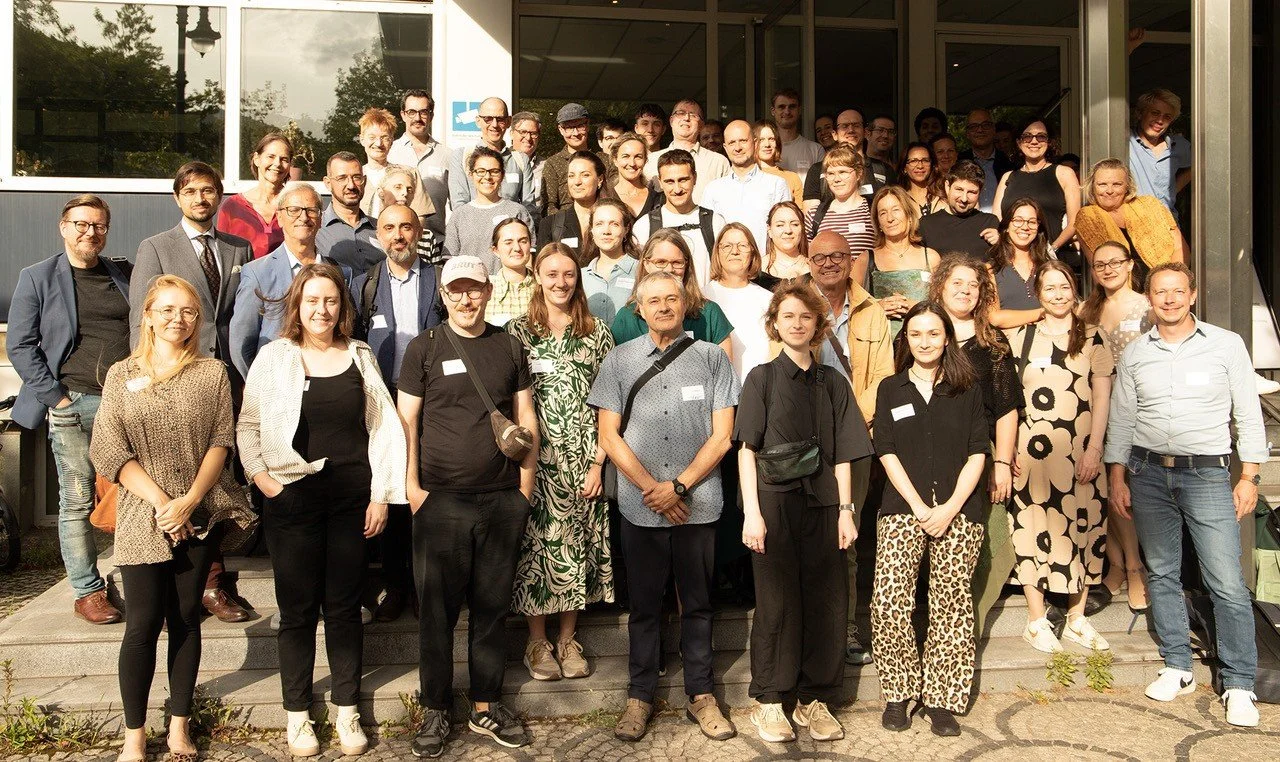
Photo of Workshop participants (Photo by: Weizenbaum Institute staff)
From Relational Money to the Polycrisis
The intellectual centrepiece of the event lay in its three keynote lectures, each addressing the role of economic sociology in navigating what Jens Beckert later termed the “polycrisis.”
Opening the conference, Mark Davis (University of Leeds) set the tone with a talk provocatively titled “How Can Zelizer Solve the Climate Crisis and What Does That Mean?” Drawing inspiration from Viviana Zelizer’s relational approach to money and valuation, Davis argued that economic sociology’s nuanced understanding of relational work and earmarking could offer tools for rethinking finance and sustainability. His examples, from a UK community crowdfunding to household decarbonization projects Davis initiated, demonstrated how sociological insights can translate into actionable design for (green) transitions.
On the second day, Jens Beckert (Max Planck Institute for the Study of Societies) delivered a keynote on “The Economic Sociology of the Polycrisis.” Beckert questioned how the discipline can maintain Weberian value neutrality (Wertfreiheit) while addressing urgent issues like democratic erosion and ecological breakdown. His talk captured a central tension of the conference: how to combine analytical rigor with normative engagement. By reframing economic sociology as a field that must grapple with both moral and institutional failures of capitalism, Beckert invited scholars to consider a sociology that is not only interpretive but also interventive.
Finally, Andrea Maurer (University of Trier) closed the conference with a powerful reflection on “How Can Economic Sociology Become Relevant for Practice and What Tools Can It Use for This?” Maurer urged scholars to move beyond markets and hierarchies to study—and even strengthen—alternative forms of organizing economic life, from commons-based governance to sustainability-oriented institutions. Her call for (again a Weberian) “action-based explanations” anchored the conference’s practical aspirations: to theorize the conditions under which alternative economic forms can emerge and endure.
Each thematic track served as a laboratory for these ambitions:
- The “Ethics” panels explored how civic innovation, taxation, and public engagement can reconfigure markets toward justice and inclusion. Discussions ranged from illicit economies and moral frameworks to the sociological design of fair infrastructures.
- The “Value” track examined the moral and institutional foundations of valuation, debt, and financial innovation. Papers on household indebtedness, moral finance, and algorithmic governance reflected a shared interest in reimagining the politics of value creation.
- The “Green” sessions placed sustainability and resilience at the forefront. Topics such as energy communities, corporate responsibility, and spatial inequalities in housing and logistics underscored the sociological dimensions of ecological transition.
- The “Work” panels confronted the realities of precarious employment and industrial reorganization. Scholars traced how digitalization, project-based management, and global uncertainty reshape labour strategies and collective action.
- Finally, “Digital” panels probed the infrastructures of data, payments, and platforms. Presentations on digital economies, fintech, and algorithmic governance showcased how technological mediation is transforming markets and social relations alike.
Toward a Sociology of Possibility
If there was one unifying sentiment emerging from the conference, it was optimism blended with, of course, a sociological realism. The “positive turn” did not signify a retreat from critique, but rather its reorientation toward constructive engagement. Across sessions, participants asked how sociologists might design markets, institutions, and technologies differently instead of merely interpreting market failures. As the closing remarks suggested, the 2025 RN09 Midterm Conference marked not only a gathering of researchers but also a collective experiment in rethinking the purpose of economic sociology itself. By blending theoretical imagination with practical concern, the Berlin meeting reaffirmed the network’s central mission: to understand the economy as a profoundly social phenomenon—and, increasingly, to help make it better.