

Dr. Sandhya A.S., Postdoctoral researcher in the Research Training Group “Cross-border labor markets: Transnational 'market makers', infrastructures, institutions” University of Bielefeld
sandhya.as@uni-bielefeld.de
On Monday, 7 July 2025, the ISA RC02 hosted the ‘Special Panel for Early Career Researchers’, a dynamic morning session that shone a spotlight on ten emerging sociologists presenting their work across four thematic clusters. Running from 09:00 to 12:45, the morning session formed part of RC02’s broader initiative to elevate the voices of early career researchers and foster meaningful scholarly exchange across generations.
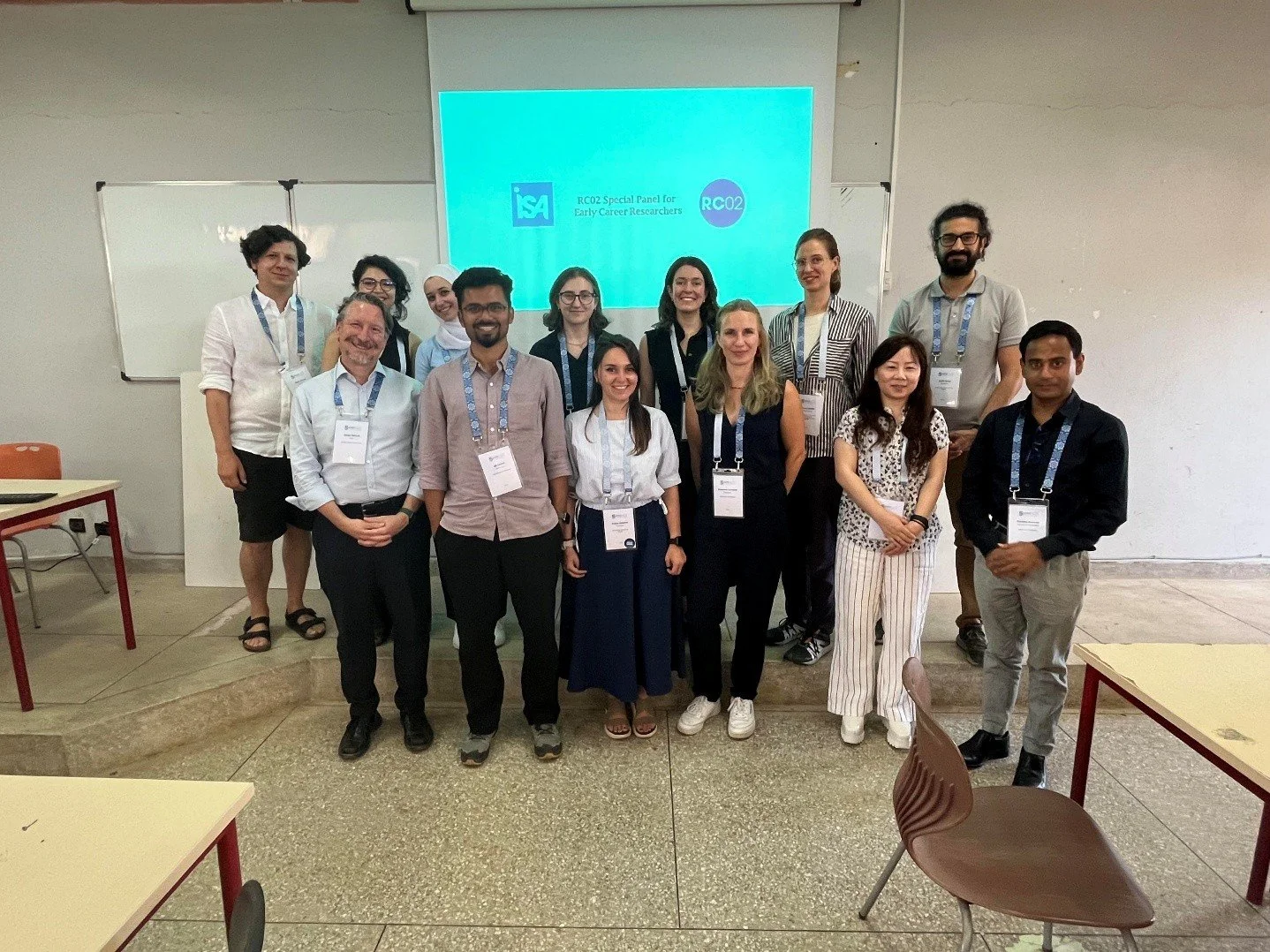
Photo of session participants.
Continuing the RC02 tradition, first organized before the 10th ISA World Congress of Sociology in Melbourne, the panel provided a welcoming space for young scholars to share their research and preliminary theoretical insights. The presentations addressed a wide range of emerging topics related to the Economy and Society, including labor, valuation, digitization, inequality, and markets. The presentations were clustered together into these themes based on a preliminary reading of the abstracts.
Ezgi Elmas (University of Duisburg-Essen) examined the segmented healthcare sector for migrant physicians in Germany, focusing on skilled-migrants from Turkey, while Kadir Engil (University of Duisburg-Essen) explored how transnational higher education connects with cross-border labor markets.
Frederike Brandt (Technical University Berlin) discussed the material conflicts surrounding lithium extraction in Argentina, and Elisabeth Schmidt (Bielefeld University) analyzed how global knowledge flows and labor mobility shape creative careers in the contemporary circus industry.
Helena Geisler (Swiss Federal University for Vocational Education and Training) presented on employers’ hiring criteria; Duaa Kattana (University of Duisburg-Essen) examined the health outcomes of displaced children in Nigeria; and Aamir Ali (University of Bielefeld) explored the resilience strategies of Indian migrant workers in Gulf labor markets.
Ardita Osmani (University of Duisburg-Essen) studied how Chinese migrants in Italy navigate mobility and inequality; Annette Gailliot (University of California, Berkeley) introduced an innovative method for reaching informal home care workers; and Michał Szewczyk (University of Warsaw) reflected on how a Polish-developed “Smile Counter” technology reshapes emotional labor.
The presentations by young scholars, across these thematic clusters, were enriched by depth and dialogue provided by our esteemed faculty discussants. As the organizer of this panel, I would like to thank Gracia Liu-Farrer (Waseda University), Aaron Pitluck (Illinois State University), Sanjeev Routray (Universiti Brunei Darussalam), and June Wang (The City University of Hong Kong) for their insights on the work-in-progress of our young sociologists. Drawing on the full papers submitted by the presenters, the discussants provided generous and constructive feedback that encouraged critical reflection and inspired lively discussion. The session also benefited from excellent moderation provided by Mark Simon (Bielefeld University), who ensured that the session ran smoothly and that each presentation received thoughtful engagement and discussion. Lastly, I would like to thank Karen Shire (RC02 President, 2023-2027) for her continued support and encouragement to the organization of the workshop.
I will conclude this piece by sharing the some of the feedback received from early career scholars on the importance of this workshop for their careers.
“I really enjoyed the format of the conference as it was a great opportunity to get detailed feedback on my paper. I also like that it was right at the beginning of the conference so that I could concentrate on all of the other presentations much better. I would definitely recommend this to other early career researchers, especially those who are new to presenting to conferences as I was, because it offered a reassuring (less terrifying) way to gain experience in presenting at conferences.” - Elisabeth Schmidt
“Participating in the 5th ISA Forum of Sociology was a special experience for me, as it was my first major conference. I was fortunate to have the opportunity to present my project in the Special Panel for Early Career Researchers before starting my fieldwork. This allowed me to receive valuable feedback, reflect on my methodology, and refine my fieldwork plan. The discussant format was particularly fruitful, as I received insightful comments on my project from an experienced scholar. I also had the chance to meet other researchers at a similar career stage, learn about their projects, and engage in inspiring discussions.” - Kadir Engil
“The Early Career Workshop was an enriching experience that not only gave us the opportunity to receive detailed feedback from discussants on our papers, but also provided a valuable platform for exchanging ideas with our peers. I would highly recommend the workshop to other young scholars who are looking for engaging discussions and meaningful academic connections.”- Ezgi Elmas
“I participated in the 5th ISA Forum of Sociology in Rabat, where I presented a work-in-progress research in the early-career researcher panel. As my first international conference, the Forum offered valuable exposure to diverse sociological subfields—labour markets, urban planning, digitization and governance, and development from a subaltern perspective. The most significant outcome for me as an early-career PhD scholar was the targeted, constructive feedback provided by the panel discussant, which will directly inform the next iteration of my paper. I strongly encourage scholars globally—and particularly colleagues from the Global South—to consider presenting at future ISA meetings and, where feasible, to engage with the ISA’s Research Committees.” - Aamir Ali