
Valentine M. Moghadam, Professor of Sociology and International Affairs, Northeastern University, Boston, v.moghadam@northeastern.edu
The planned Handbook of Feminist Political Economy of Middle East and North Africa (hereafter MENA), a project of the network known as FEMME, originated by political scientist Gamze Cavdar, was the basis for a hybrid workshop that convened in mid-September 2025 at the University of Arkansas, with generous funding from the King Fahd Center. The book will fill an important gap in the literature on women and work in the Middle East and North Africa region, spanning the disciplines of economics, sociology, and political science.
Over two decades ago, the late Professor Mine Çınar edited The Economics of Women and Work in the Middle East, which appeared in 2001 (and in which I have a chapter). Nadereh Chamlou and Massoud Karshenas also edited, and contributed to, Women, Work, and Welfare in the Middle East and North Africa (published in 2016), to which I also contributed. Since then, many excellent journal articles and policy papers have appeared, but Gamze and I felt that it was time for a new, updated book that could cover a wider array of themes: patriarchy, varieties of gender regimes, and women’s work; patterns and trends in female labor-force participation (FLFP) within and across countries; and institutional influences, including the role of family laws, social policy, military spending, overseas development aid, gender-responsive budgeting ), and attitudes and values toward women, work, and family. Countries covered include Egypt, Iran, Jordan, Morocco, Palestine, Israel. We envision a book with 12 chapters authored or co-authored by experts in their respective fields.
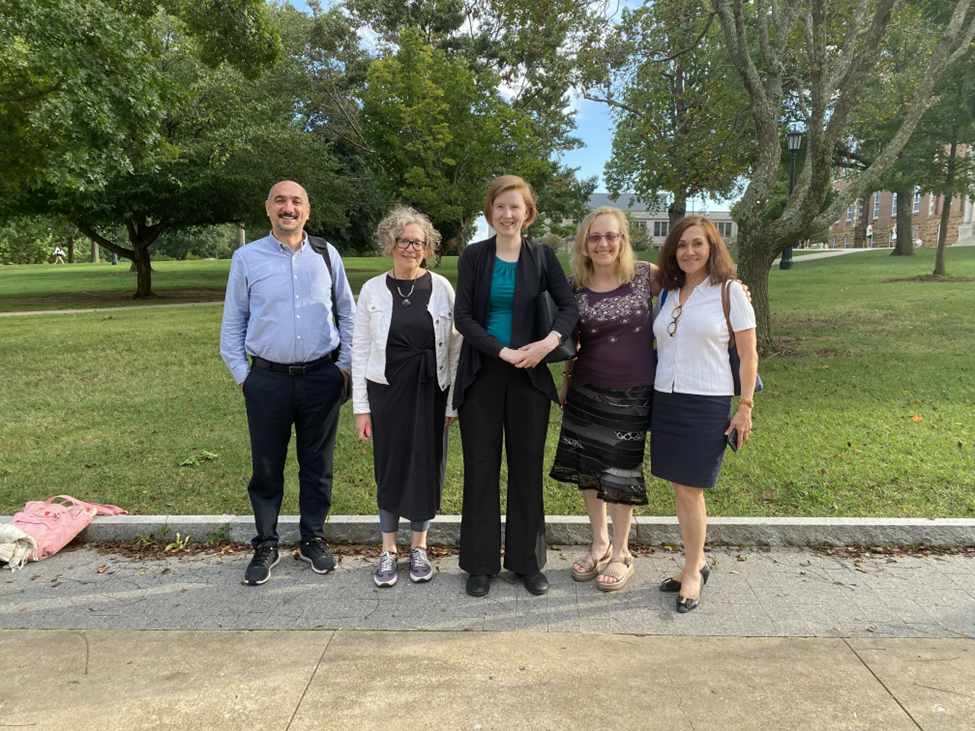
Photo of some of the workshop participants who attended in person: from left to right, Valentine M. Moghadam, Jennifer Olmsted, Caroline Krafft, Amalia Sa’ar and Adem Elveren
Some 13 social scientists took part in the conference, whether in person or virtually, with rich discussions of the issues presented, enabling identification of similarities and differences across the papers. For example, the papers presented showed low and declining FLFP in Egypt, Iran, and Jordan, especially among women with less than secondary schooling. This has occurred despite rising educational attainment, lower fertility, and rising costs of living. This is what political economists of the region call the “gender paradox.” Rana Hendy and Caroline Krafft focused on Egypt, Alma Boustati examined Jordan, and I addressed Iran.
In addition, the highest FLFP rates are found among university-educated women – including the Israeli-Palestinian (presented by Amalia Sa’ar) and Turkish women (by Emel Memiş and Yavuz Yaşar) discussed in two separate papers – but these rates include high female unemployment. In other words, the supply of (educated) women is considerable, but the demand side is weak. In many cases, the absence of generous welfare policies for work-life balance, women tend to drop out of labor force after marriage and there is a tendency toward early retirement, partly to care for grandchildren.
Morocco is an interesting case of an Arab state integrated in the world-economy and aligned with the capitalist democracies of the West (as well as a signatory to the controversial Abraham Accords)[i]. It enjoys a degree of foreign investment as well as aid, and has been a regional leader in adoption of gender-responsive budgeting, which is promoted by Western partners. And yet its female and youth unemployment rates remain high, along with high rates of reported violence against women. The case of Morrocco was analyzed by Nadia Mannaoui and Thera Van Osch during the workshop.
The region is further characterized by states with off-the-charts military spending as well as GDP, and large populations of migrant workers (the Arab sheikhdoms), along with peripheral, aid-dependent economies (Jordan, Yemen), and states with higher incomes and large populations (e.g., Algeria, Egypt, Iran, Turkey). In most cases, military spending has a crowding-out effect on the social expenditures that benefit women and their families as discussed by Adem Elveren. All MENA states are characterized by a considerable population of young people in what the ILO calls NEET – not in education, employment, or training. What is more, continued oil production and exports produce carbon emissions that affect local populations and ecology and beyond. One wonders how women in the STEM disciplines might be able to tackle these issues – if they had more access to productive research opportunities or decision-making positions in both public and private sectors.
The workshop also examined broader regional issues, including the impact of ODA and humanitarian aid on gender inequality (Jennifer Olmsted), trends from the Arab Barometer surveys (Amaney Jamal), and varieties of gender regimes (Ece Kocabıçak).The forthcoming book, titled Handbook of Feminist Political Economy of Middle East and North Africa (2027), will fill a crucial gap in understanding women’s work in the MENA region, bringing together insights from economics, sociology, and political science.
Our thanks go to Dr. Shirin Saedi, who provided the generous funding for the workshop, and her associates at the Center.
[i] The Abraham Accords are a set of agreements that established diplomatic normalization between Israel and several Arab states, beginning with the United Arab Emirates and Bahrain.